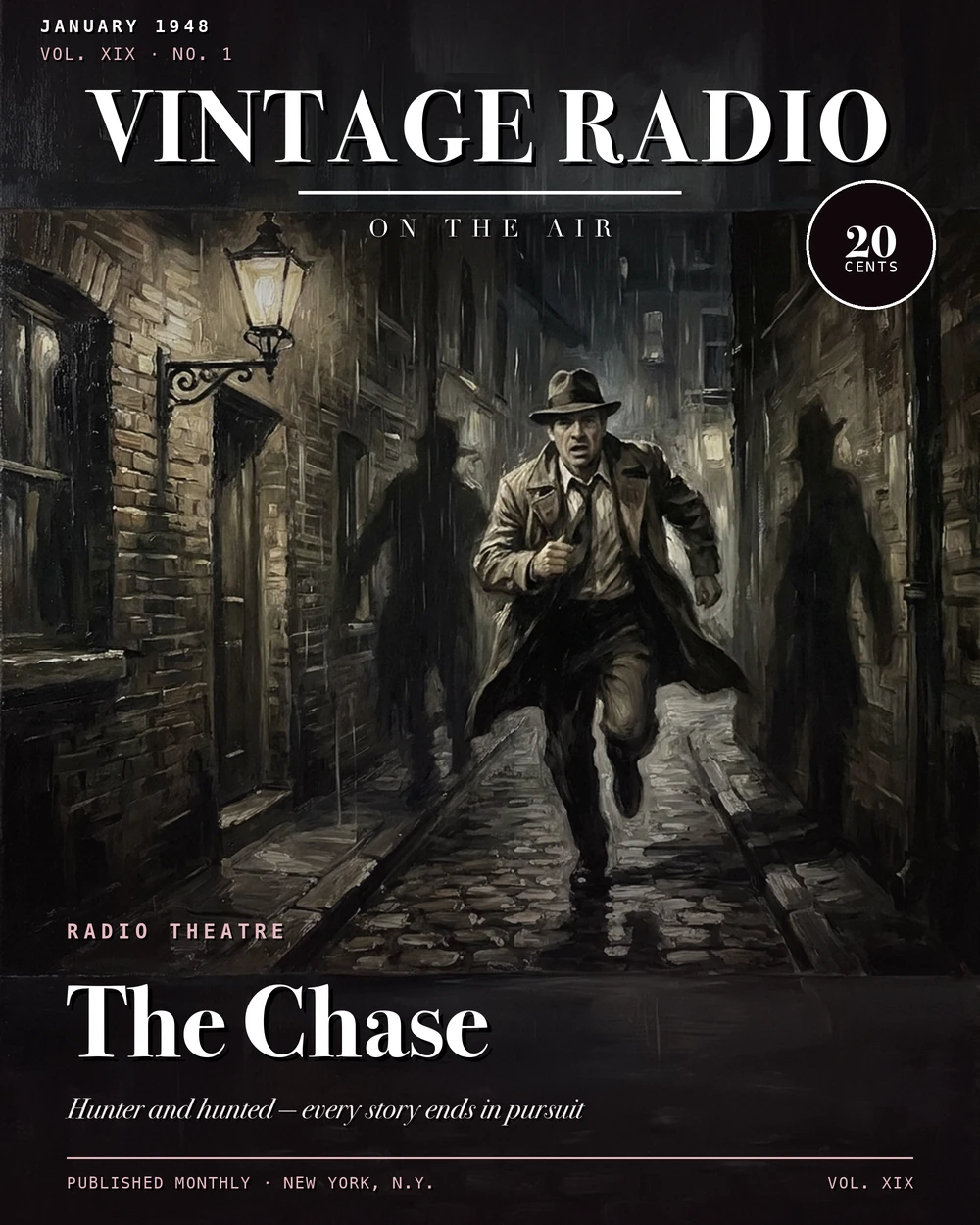
The Chase
The Idea Behind It
The Chase opened each episode not with words but with sound — a lone bugle calling the start of a fox hunt, then dogs baying, then the slap of running footsteps, then a gunshot, and finally those footsteps slowing, stumbling, and falling silent. In about fifteen seconds, the show told you everything it was going to be about. The premise was simple and unvarying: hunter and hunted. What changed each week was who was running and why.
NBC launched the series on April 27, 1952, airing Sunday afternoons at four o'clock. It ran for 55 episodes before the network pulled it from the schedule in June 1953, replacing it with NBC's Summer Symphony series. The show was transcribed — recorded in advance rather than broadcast live — and distributed on NBC Orthacoustic transcription discs, the network's proprietary high-fidelity recording format. It ran unsponsored, sustained entirely by NBC rather than any commercial advertiser, which says something about where radio economics stood by the early 1950s. High-budget radio thrillers of the preceding decade had become harder to justify financially, and The Chase operated in that transitional space between what radio had been and what it was becoming.
The stories themselves were described at the time as highly melodramatic and often improbable, which was neither a bug nor an accidental quality — it was the essential texture of the thing. Each half-hour episode delivered an anthology tale of people in flight: a man drawing strange inspiration from a big cat's escape from the zoo, a woman making frantic phone calls to find a judge before her husband is executed, a newspaper reporter caught in circumstances beyond his control. The genre ranged across adventure, crime drama, and occasional science fiction. What held it together wasn't a recurring character or setting but the structural premise: somebody was always running, and something was always catching up.
Lawrence Klee
The Chase was created, produced, and largely written by Lawrence Klee, who was born in 1915 and died of a heart attack in 1957 at age 42. His death, coming less than four years after the show ended, cut off a career that had covered a remarkable amount of ground in a short time.
Klee came to radio sideways. He was the son of vaudeville performer Mel Klee and had joined his father's act at age ten. He started writing for radio in 1940 while still a pre-med student at the University of Alabama, breaking in by writing gags for comedian Jack Gilford. During World War II, the U.S. Army commissioned him to create a radio drama called Chaplain Jim — USA, for which he wrote 303 episodes and later received a citation from the U.S. Treasury Department War Finance Committee in 1946 for outstanding wartime service. His pre-Chase radio credits included Mr. Keen, Tracer of Lost Persons and other Hummert productions, along with ABC's The Fat Man and The Clock.
He also created the television crime series Man Against Crime, which ran on CBS and NBC from 1949 to 1956, producing 122 episodes — the comic book character Mike Barnett was based on it. He wrote the 1947 documentary film The Roosevelt Story, a dramatized account of Franklin D. Roosevelt's life. His papers, covering 1936 to 1994, are held at the American Heritage Center at the University of Wyoming, and they include scripts for The Chase alongside material from The Clock, The Fat Man, Mr. Keen, Backstage Wife, Front Page Farrell, and Chaplain Jim, U.S.A. — a wide record of what mid-century radio drama actually looked like in manuscript.
One practical note on the scripts: according to Martin Grams Jr.'s reference work on the series, some episodes of The Chase were recycled from earlier radio series, including The Clock, Inner Sanctum Mysteries, Radio City Playhouse, and Dimension X. The episode "Long Distance," featuring Jan Miner as a woman desperately trying to reach a judge in time to halt her husband's execution, appears to have originated as a Radio City Playhouse piece before it arrived at The Chase. Recycling scripts wasn't unusual for the period, particularly on an unsponsored series, but it does give the catalog a slightly composite character.
The Cast
The show drew from New York's deep pool of working radio actors, and the roster was large enough that it reads almost like a directory of the city's dramatic talent in 1952. The core group included Karl Swenson, Lucille Wall, Kermit Murdock, Larry Haines, Stefan Schnabel, Luis Van Rooten, Vinton Hayworth, Wendell Holmes, Norman Rose, Edgar Stehli, Joe DeSantis, Mandel Kramer, Amzie Strickland, Donald Buka, Bryna Raeburn, Grant Richards, Ann Thomas, John Gibson, Elaine Rost, Staats Cotsworth, Sarah Burton, Helen Claire, Roger DeKoven, Leon Janney, Nelson Olmsted, Jan Miner, Maurice Tarplin, Ian Martin, Virginia Payne, Arnold Moss, Paul McGrath, Ed Jerome, Ivor Francis, Bill Quinn, Santos Ortega, and Ralph Bell, among others. Fred Collins served as announcer. Directors included Walter McGraw, Daniel Sutter, Edward King, Fred Weihe, and James Harvey.
A few names in that list carried particular weight for genre radio listeners. Maurice Tarplin was the narrator of The Mysterious Traveler. Paul McGrath had hosted Inner Sanctum Mysteries. Norman Rose was associated with X Minus One. Announcer Fred Collins also worked on X Minus One, and director Fred Weihe had directed that series as well. The overlap wasn't coincidental — The Chase and X Minus One shared a recognizable production world, and audiences who knew one series would have heard familiar voices in the other.
Santos Ortega, a prolific New York actor who played Commissioner Weston on The Shadow and the title character in Bulldog Drummond from 1942 to 1943, also appeared in the series. Ralph Bell — born Ralph Scognamiglio on November 27, 1915 — brought credits from Yours Truly, Johnny Dollar and Dimension X. June Foray, born June Lucille Forer on September 18, 1917, in Springfield, Massachusetts, also appeared; she would later become best known as the voice of Rocky the Flying Squirrel and Natasha Fatale on The Bullwinkle Show, and she died July 26, 2017, at age 99. Nelson Olmsted starred in "Professor Calvin and the Voice," a supernatural episode within the series that shows how far the anthology format ranged.
The Television Angle
NBC had originally conceived The Chase as a television psychological drama. The radio version was intended to test the concept before committing to a television adaptation. That context helps explain why the show was structured the way it was — the anthology format and the clean central premise of hunter and hunted translated naturally from a pitch document to a broadcast to, theoretically, a screen.
A television version did move into production during May 1953, with Doug Fowley attached to star as both narrator and performer. The project was abandoned before it aired. The radio version was cancelled at roughly the same time, replaced on the NBC schedule by the Summer Symphony series. Both versions — the test and the intended result — were gone within the same season. Whatever The Chase was proving, NBC apparently decided not to build on it.
The opening announcement changed across the show's run. One version leaned on the fox-hunt imagery that anchored the signature sound sequence. A second version, which appears to have been used more frequently, invoked "the voice of authority" and "laughter as counterpoint" — a slightly more abstract frame for the same essential content. The show knew what it was doing with sound; the dual openings suggest Klee and his directors were still working out how to describe it in words.
What Survives
Fifty-four of the original fifty-five episodes are preserved in the Joe Hehn Memorial Collection, a nearly complete record of a short-lived, unsponsored NBC series from the early 1950s — meaningful luck for a period when preservation was inconsistent and commercial incentive to maintain recordings was low. Hehn (1931–2020) was a pioneering collector whose work began as the OTR hobby first emerged in the 1960s; a preservationist crew calling themselves "The Knights of the Turning Table" digitized the holdings.
The run ended June 28, 1953, just over a year after it began. Klee died four years later. The show never returned and never became a television series. What remains is one full season of a particular kind of early-50s radio — lean, melodramatic, built around a single unvarying structural hook — and a nearly intact record of what that sounded like.